
Vernon Directory Runs by Year
Vernon city directory research begins with titles that changed as publishers grouped Rockville with nearby towns. Rockville Public Library keeps local-history material in its Community Room, including city directories, family biographies, town reports, and Rockville High School yearbooks. The collection is used in the building. Researchers should consult staff and may be asked to leave a driver license while handling irreplaceable items. Call 860-875-5892 first and request a year and title, since a catalog lead does not prove that every neighborhood appears in every volume.
| Directory title | Years found | Repository lead | Use |
|---|---|---|---|
| Rockville Directory | 1890 | Genealogy catalog, verify locally | Name and business search |
| Rockville/Vernon variants | 1896-1924, selected years | Library and catalog leads | Names and street changes |
| Rockville/Vernon/Ellington/Tolland | 1927-1960, selected years | Regional collections | Check town coverage |
| Vernon-labelled editions | 1949-1960; 1981 lead | Catalog lead, confirm copy | Town-name search |
| U.S. City Directory listings | 1879-1966, many listed years | Genealogy finding aid | Verify each volume |
The broad U.S. City Directory listing includes many years from 1879 through 1966, but it is a finding aid rather than an official Vernon shelf inventory. Later evidence identifies Price & Lee as a major publisher. The full early publisher sequence, a complete scan set, and a final printed year were not confirmed. No verified reverse or criss-cross run was found either. Ask whether the physical volume has a street-order section before treating it as an address-to-name directory.
Vernon Research at Rockville Library
The Rockville Public Library local-history collection is the main in-person access point. Along with city directories, its shelves and film include town and city reports, family histories, cemetery and church works, architectural material, and newspapers. Some local-history titles have a second circulating copy, shown by a regular call number beside the protected LH copy. Record the exact title, edition, call number, page, and kind of mention. A caption, narrative, cemetery list, and directory entry do not carry the same weight.
Useful companion titles include History of Rockville, Building the Loom City, Vernon Vignettes, and Vernon through the Years 1808-1983. Staff can help determine whether a newspaper date is available on microfilm or through the Connecticut Digital Archive. There is no published complete obituary index or reverse-directory inventory, so a focused question works best: give the surname, street variant, and year range.
Vernon Directories Began in Rockville
Local evidence puts Rockville and regional telephone directories in the late 1870s. That early start reflects Rockville's mills, shops, and dense village center along the Hockanum River. Historical searches should try Rockville, Vernon, and combined regional labels. Vernon separated from Bolton in 1808, while Rockville and Vernon consolidated on July 1, 1965. A person did not necessarily move merely because the place label changed between records.
The Vernon Historical Society's telephone history gives rare detail about what these lists captured. Sill Brothers served as druggists and telephone-office managers in 1887, and Minnie C. Sill was an operator. The office was at 15 Park Place in 1889, then at the Rockville National Bank at 6 Elm Street by 1890. Those facts show how an entry can connect a person to a shop or service point as well as a home. In 1912, Rockville had 828 telephones. By 1922, a symbol marked home phones, a useful local key when reading later editions.
| Late 1870s | Regional telephone-directory history begins |
|---|---|
| 1890 | A Rockville Directory appears in the catalog run |
| 1922 | A symbol marks a home telephone |
| Mid-century | Price & Lee appears in publisher evidence |
| 1965 | Rockville and Vernon labels consolidate |
Check Vernon City Directory Years
The Tolland County directory catalog supplies a practical year list to check before contacting a repository.
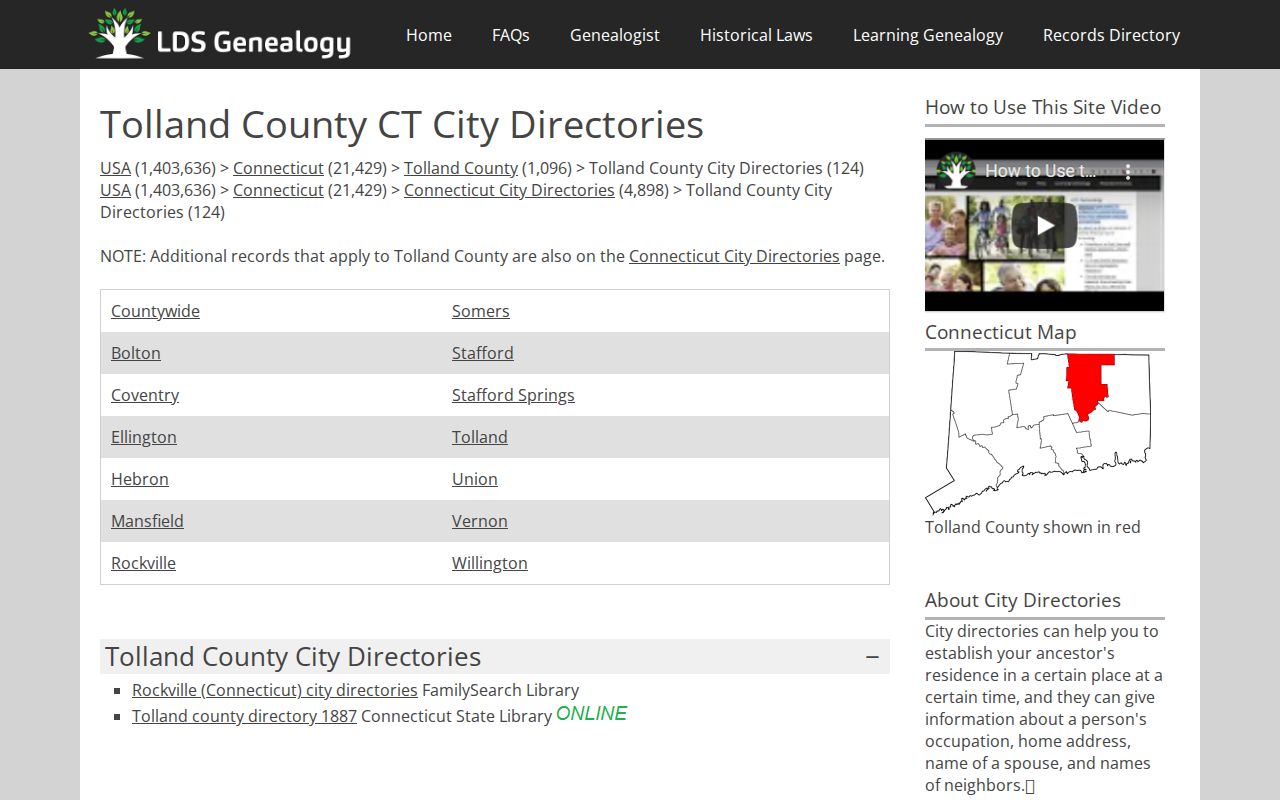
The captured catalog is a lead, not proof of a complete local holding. Match its title and year against the library copy, then cite the actual volume or page image used.
Read a Vernon Directory Entry
A Vernon city directory entry should be transcribed before it is interpreted. The local telephone history confirms resident name, occupation, home or work address, telephone listing, and a special home-phone symbol by 1922. It does not confirm spouse parentheses, renter or owner marks, or a standard abbreviation key for every run. Those fields require inspection of the actual volume. Copy the title page and key with the entry so later readers know which rules apply.
| Printed name | Copy spelling and initials exactly |
|---|---|
| Occupation | Historical work context, sometimes tied to an address |
| Home or work address | Keep the label and street form shown |
| Telephone notation | By 1922, a symbol could distinguish a home phone |
| Unknown marks | Check the volume key before assigning meaning |
- Criss-cross directory
- A directory arranged by street address rather than surname. Its presence in Vernon volumes must be checked.
- Householder index
- A name or address list for the person identified as heading a household, not a full roster of occupants.
- Abbreviation key
- The page defining a publisher's shortened terms and symbols. Save it with each copied entry.
Vernon Newspapers Extend Directory Clues
When a name vanishes between city directories, local papers can supply a move, marriage, death, civic notice, or business change. Vernon Historical Society identifies the Tolland County Journal for 1867-1884, Rockville Journal for 1885-1899 and 1911-1968, Rockville Leader for selected years from 1902 through 1964, and Tri-Town Reporter for 1973-1984. The library houses reader-only microfilm. CTDA makes the 1911-1953 Rockville Journal segment searchable, while later parts of the 1911-1968 run are being uploaded in phases.
The local newspaper digitization project shows how online search and library film fit together.
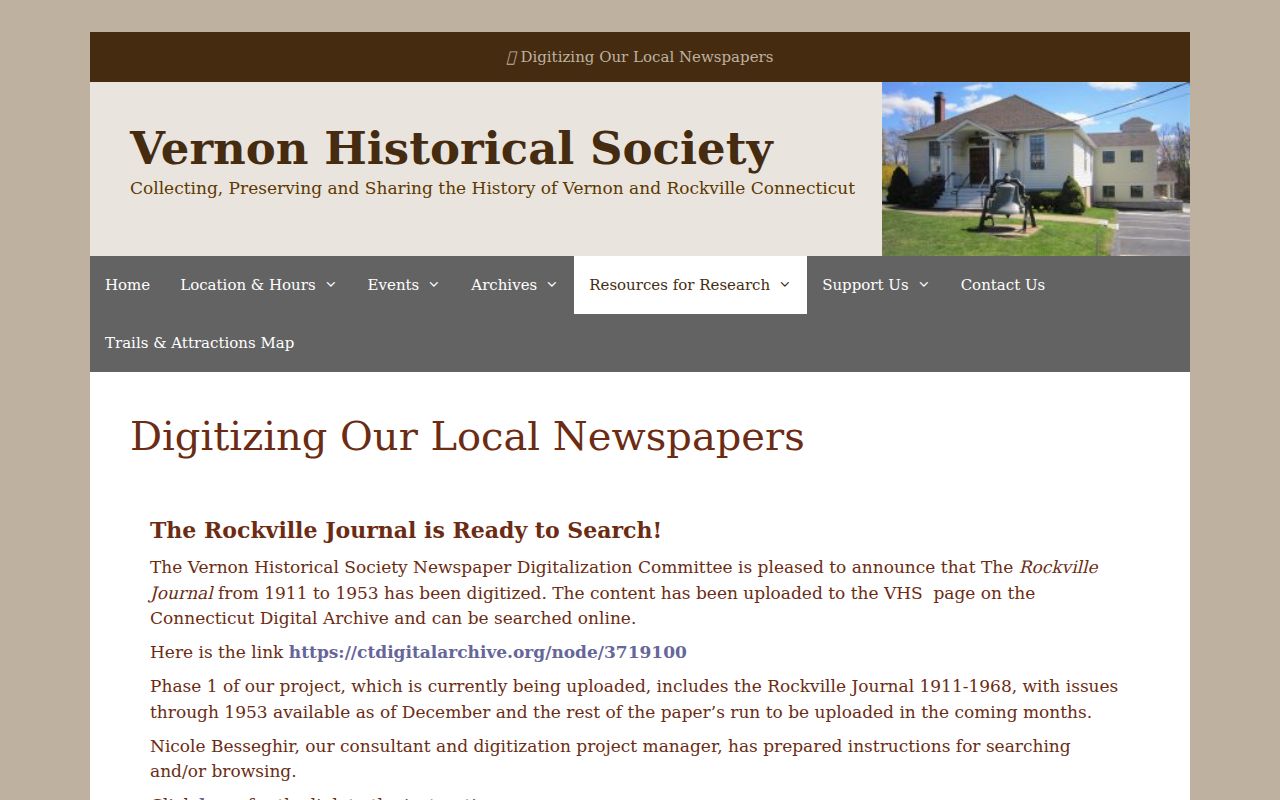
Search names, streets, firms, churches, and cemeteries. Compare OCR text with the page image because old type and damaged film can distort names.
Map Vernon Names Beyond Directories
Historical maps place a directory address in its physical setting. Vernon Historical Society holds an 1855 Rockville map, three 1869 owner-by-property maps, and bird's-eye views from 1877 and 1895. Library of Congress Sanborn coverage for Rockville includes 1885, 1892, 1897, 1903, 1911, and 1921. These fire-insurance maps show structures and street form, though no complete rural Vernon set was located.
Yearbooks, cemetery books, biographies, and church histories catch people who may not be listed as household heads. Rockville High School yearbooks can help reconnect a classmate to a class year. Old North Burial Ground names and dates may close a family trail. A map label or yearbook photo remains a lead. Pair it with a dated directory, newspaper, census, deed, probate item, or vital record before concluding that two similar names belong to one person.
Search Vernon and Regional Titles
One household may appear under Rockville/Vernon in one year and a four-town regional title in another. Search hyphenated and slashed labels, plus Vernon/Ellington, Vernon/Ellington/Tolland, and Tolland/Vernon. In mill-era records, also test Rockville and a known village, company, or church name. The directory title describes editorial coverage, not a modern municipal boundary.
A street can change too. Market Street disappeared during Rockville's 1960s urban renewal. No official number-by-number conversion table was found. If an entry points there, compare the directory with an old newspaper, the 1869 owner map, Sanborn sheets, and current parcel geography. Mark any proposed modern match as uncertain until a deed, map, or town record provides the bridge.
Trace Families Through Vernon Directories
Use Vernon city directories as dated snapshots. Federal census schedules become public after 72 years, so the 1950 census is available while 1960 is due in April 2032. A directory can bridge the years between those ten-year counts, but a missing name can mean a move, death, spelling change, omitted household member, or skipped edition. Keep those possibilities open until another source resolves them.
- Choose the edition nearest the event and search all surname and place-name variants.
- Copy initials, occupation, address, phone mark, and source page without expanding unknown terms.
- Check the prior and next available editions. Note changes and each year with no listing.
- Pair the entry with the closest public census, using street and household order when spelling differs.
- Test the result against a newspaper, map, deed, probate item, cemetery source, or vital record.
Modern address-keyed records belong in the Vernon street directory workflow. For the historical shelf, the strongest citation preserves the volume title, publisher if known, year, page, repository, and whether the evidence came from a scan or the original.